
Admin
06-10-2026
Lab-grown diamonds have changed the diamond business in the modern world by giving jewelers and buyers a faster and cheaper option than natural diamonds. These diamonds were made in controlled lab settings and have the same chemical makeup, crystal structure and visual brilliance as mined stones, so they look exactly the same.
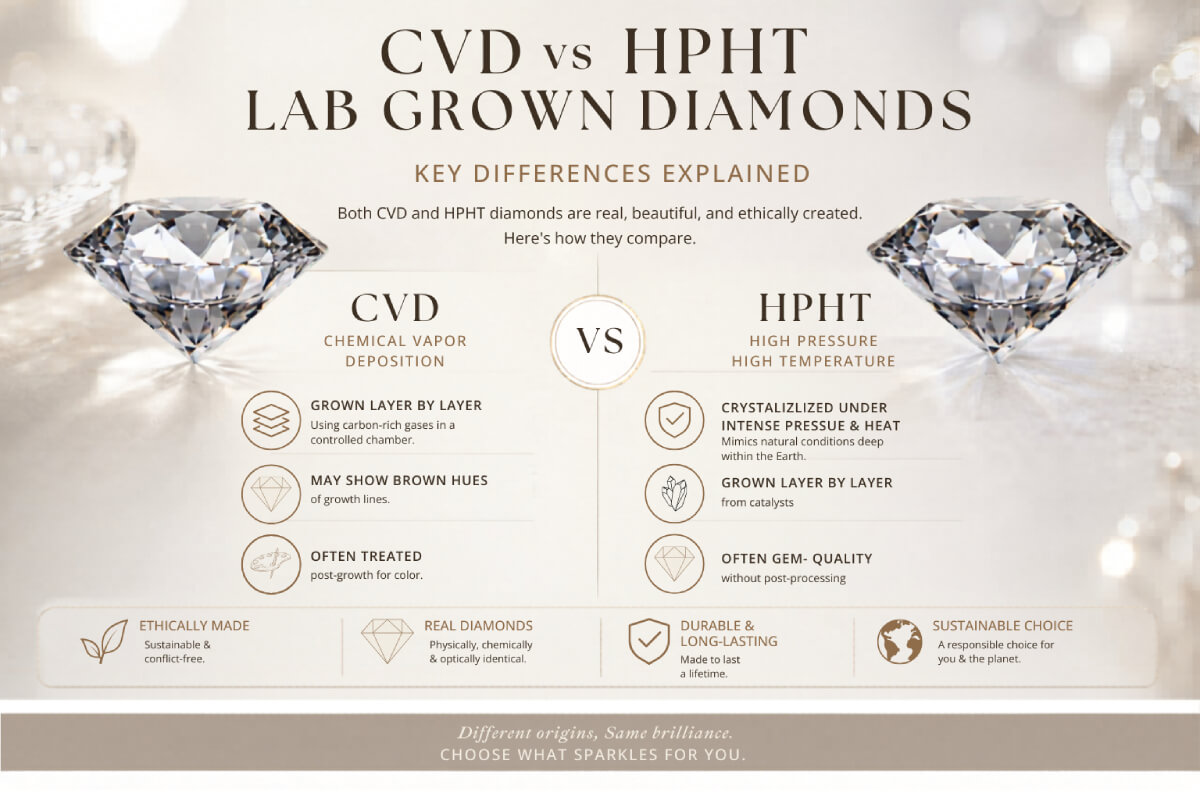
The main difference between CVD and HPHT lab-grown diamonds is how they are made. Both methods imitate how diamonds form in nature, but they do so in very different ways. One builds the diamond layer by layer, while the other imitates the extreme heat and pressure found deep within the earth.
Jewelers and professional buyers need to know the difference between CVD and HPHT diamonds because each method can affect the look and price of the diamond. In this guide, we'll explain both methods of production in detail and help you see how they stack up in real-world situations.
Lab-grown diamonds are real diamonds that are made in controlled lab settings using cutting-edge technology that mimics how diamonds form in nature over time. They look and feel the same as real diamonds because they have the same chemical makeup, crystal structure and optical properties.
The only thing that makes them different is where they come from. These diamonds are made using modern methods like chemical vapor deposition (CVD) and high pressure high temperature (HPHT) instead of within the Earth which would require large scale mining degrading natural habitats. Lab creation allows for the formation of high-quality diamonds at a faster speed and in a more eco-friendly manner.
High Pressure High Temperature (HPHT) is one of the earliest methods used to create lab grown diamonds, designed to closely replicate the natural conditions under which diamonds form deep within the Earth.
HPHT can also be referred to as a process that enhances the color of a diamond through a high pressure high temperature color treatment. This would transform a diamond yellow in color to a whiter, more brilliant quality. This method is known for making diamonds with strong crystal structures.
Understanding the CVD vs HPHT lab grown diamonds comparison is essential for buyers and jewelers evaluating diamond quality and production methods. While both processes create real diamonds, the differences in how they are formed can influence their characteristics, appearance and cost.
|
Feature |
CVD |
HPHT |
|
Process |
Uses chemical vapor deposition, where carbon-rich gases form a diamond in a controlled chamber. |
Uses high pressure and high temperature to replicate natural diamond formation conditions. |
|
Growth |
Diamond grows layer by layer on a seed crystal with controlled precision. |
Diamond forms under extreme pressure and heat, similar to natural underground formation. |
|
Color |
May require post-growth treatment to improve color in some cases. |
Often used for both diamond growth and color enhancement processes. |
|
Clarity |
Typically shows fewer inclusions due to controlled growth conditions. |
May contain metallic or pressure-related inclusions depending on the growth process. |
|
Cost |
Generally more cost-efficient due to scalable production methods. |
Slightly higher production cost due to energy-intensive processes. But can be manufactured in bulk. |
Both methods produce high-quality diamonds and the difference between CVD and HPHT diamonds largely comes down to production technique, internal characteristics and how the diamond is processed after growth.
There is no one best way to compare CVD vs HPHT lab-grown diamonds. It all depends on what you want to use them for, how much you can spend and how good you want them to be.
The comparison between CVD and HPHT diamonds depends on practical factors such as cost, production scale and intended use. While both methods produce high-quality lab-grown diamonds, CVD is often preferred for scalable production, whereas HPHT is commonly used for both growth and enhancement processes. The better option ultimately depends on specific requirements and sourcing priorities.
CVD diamonds are normally cheaper to create; however, HPHT diamonds may cost more to make because the procedure takes a lot of energy. But both procedures make diamonds that look practically the same to the naked eye when it comes to how they look and how long they last.
Most customers and jewelers don't pick one approach as the best; instead, they think about quality, price and where they receive their goods.
From a visual standpoint, there is no noticeable difference between CVD and HPHT lab grown diamonds. Both types have the same brilliance, sparkle and overall appearance as natural diamonds, making them virtually indistinguishable to the naked eye.
Any differences between the two are typically internal and can only be identified using advanced gemological equipment. Professional laboratories and experts analyze factors such as growth patterns and inclusions to determine whether a diamond was created using CVD or HPHT methods.
Both CVD and HPHT methods have transformed the lab-grown diamond industry by offering reliable alternatives to natural diamonds. While their production processes differ, both are capable of delivering high-quality diamonds suitable for a wide range of applications.Understanding these differences helps buyers and professionals make informed decisions based on their specific needs, budget and sourcing preferences. You can also explore our lab-grown diamond inventory to find options that match your requirements.
FAQ
The main difference lies in the production method CVD diamonds grow layer by layer using gas, while HPHT diamonds are formed under extreme pressure and heat.
Neither method is universally better; the choice depends on factors like quality, cost, and specific use cases in jewelry or manufacturing.
No, both CVD and HPHT diamonds look identical to the naked eye and have the same brilliance and sparkle as natural diamonds.
Yes, both are real diamonds with the same chemical composition, crystal structure, and physical properties as natural diamonds.